Stannis–Renly conflict
A Clash of KingsStannis–Renly conflict is the political and personal rupture between the Baratheon brothers over the Iron Throne. Stannis understands the dispute as a matter of lawful succession: Robert’s crown should pass to him, while Renly’s seizure of Storm’s End and proclamation as king represent theft layered upon an older injustice. Renly, by contrast, treats legitimacy as inseparable from acceptance and power. Their conflict therefore sets inherited right against popular recognition, turning brotherhood into a contest in which compromise itself becomes surrender.
Origins in Inheritance and Resentment
Stannis’s grievance begins before either brother openly takes the field. He recalls that Robert sent him to Dragonstone to root out the king’s enemies and that he built Robert’s fleet and performed his duties as a younger brother. Yet Robert awarded Storm’s End, the Baratheon stronghold and its incomes, to Renly instead. Stannis regards the decision as a denial of the rights that should have followed when Robert took the Iron Throne: Storm’s End had belonged to House Baratheon for three hundred years, and in his view should have passed to him rather than to a younger brother who had done little to earn it.
The material consequences of that choice sharpen the emotional wound into a strategic crisis. Dragonstone is old and strong, but its island holdings are thinly populated and command the allegiance of only a handful of lesser lords. Even with sellswords brought from Myr and Lys, Stannis’s host is too small to challenge House Lannister. Renly’s possession of Storm’s End has thus deprived Stannis not merely of honor or income but of the men and political network needed to enforce his claim. The succession dispute is simultaneously a family grievance and a calculation of military resources.
Rival Claims to the Crown
Stannis sees Renly as a child who has no achievement capable of justifying a crown. He reduces Renly’s public life to council-room jests with Littlefinger and tournament display, where he wears splendid armor only to be unhorsed by a better man. Behind the contempt lies a strict hierarchy of duty: an elder brother who served Robert should have been obeyed by the younger, just as Robert should have recognized Stannis’s precedence. Renly’s ambition appears to Stannis not as a competing interpretation of politics but as treason within the bloodline.
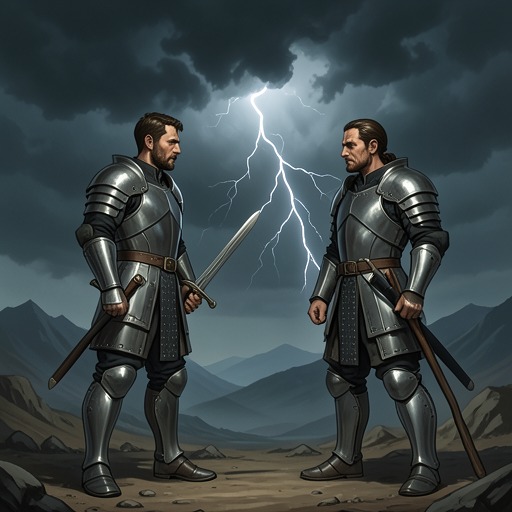
When the brothers meet, Renly’s manner exposes the opposite logic. He arrives beneath a crowned stag, dressed in green velvet and gold, with Brienne carrying his banner, and insists on being addressed as “King Renly.” Stannis answers with the curt form “Lord Renly,” refusing even the language that would acknowledge his brother’s sovereignty. Renly argues that the entire realm rejects Stannis: old men deny him in their death rattles, unborn children deny him in their mothers’ wombs, and no one wants him as king. The statement is cruel, but it identifies the practical foundation of Renly’s claim: banners, followers, and public consent outweigh an inheritance rule that cannot command obedience.
Stannis declares that the Iron Throne is his by right and defines every denier as a foe. This absolute division expands the conflict beyond Renly. The Starks, he says, seek half his kingdom; the Lannisters have stolen his throne; and Renly has taken swords, service, and strongholds that belong to him. All are usurpers. In political terms, Stannis redraws the realm into a field of enemies, making alliance difficult precisely because he treats recognition of his right as the prerequisite for cooperation rather than as a result that must be negotiated.
The Failed Parley
The brothers’ meeting offers a final chance to convert rivalry into accommodation, but both interpret concession as humiliation. Renly proposes that Stannis dismount, bend his knee, and swear allegiance to him. Stannis refuses immediately. Renly reminds him that he once served Robert and asks why he will not serve Renly, but the comparison only intensifies the difference between them: Robert was the elder brother and reigning king, whereas Renly is the younger brother who has crowned himself.
Stannis nevertheless makes an offer before the battle begins. Pointing Lightbringer at Renly, he claims mercy and grants his brother one night to reconsider. Renly may strike his banners, come to Stannis before dawn, retain Storm’s End and his old seat on the council, and even serve as heir until Stannis has a son. The terms preserve Renly’s rank and much of his power, but they require submission to Stannis’s superior claim. Renly answers by directing attention to the multitude of banners across the fields and questioning whether a few strips of cloth can make Stannis king. Stannis, in turn, insists that banners cannot create lawful sovereignty. The value at stake shifts from family loyalty to the irreversibility of public allegiance: Renly’s strength makes Stannis’s legal claim look impotent, while Stannis’s terms make Renly’s kingship look illegitimate.
The parley ends with the brothers still armed and their positions unreconciled. Stannis’s threat that he will destroy Renly if he does not yield gives the conflict its final shape. Mercy is offered only within the framework of submission, and Renly’s independence is treated as a form of treason. The language of kinship briefly appears through an appeal to the mother who bore them both, but it cannot overcome the political identities each brother has adopted.
A Wider Crisis of Legitimacy
The conflict is embedded in a realm where competing authorities constantly declare one another unlawful. Stannis names the Lannisters thieves and Renly a traitor, while the Lannisters seek to discredit Stannis by presenting his alliance with Melisandre as an attack on the established gods. In the council at King’s Landing, the proposed response is to punish anyone who speaks of incest or calls Joffrey a bastard by cutting out his tongue. The debate reveals how succession disputes are fought through speech as well as armies: the regime attempts to suppress the accusation rather than answer it, and Tyrion observes that silencing a man does not prove him a liar but tells the world that his rulers fear his words.
Yet rumors in King’s Landing also show that Stannis’s claim has a popular life independent of his personality. The City Watch is drawn largely from the smallfolk, many of whom remember the sack of the city under Tywin Lannister, the murder of King Aerys, the deaths of Rhaegar’s children, and Eddard Stark’s execution. In pot-shops, winesinks, brothels, barracks, and guardhalls, people speak of how much better things were under Robert and hint that matters might improve again with Stannis on the throne. These rumors do not establish that Stannis is beloved; they demonstrate instead that the Lannister hold on legitimacy is fragile and that succession is being judged through memory, grievance, and expectation as well as bloodline.
The contrast between brothers also exposes the limits of simple legal and moral systems. Stannis follows the duty-based principle that the crown belongs to the proper heir, even when that claim isolates him. Renly follows the consequential logic that the ruler able to command the realm is the ruler most capable of securing it. Neither framework resolves the conflict because each treats the other’s foundation as invalid. Stannis cannot accept popularity as a substitute for right, while Renly cannot accept right without the power and consent that make rule possible.
Consequences and Narrative Significance
The conflict transforms the Baratheon family’s internal hierarchy into another front of the War of the Five Kings. Stannis’s old resentment over Storm’s End supplies the emotional charge, but the stakes are national: the brothers command rival coalitions, divide armies that might otherwise oppose the Lannisters together, and make the Iron Throne the object around which every claim to lawful rule is measured. Their failure to unite allows the broader political order to remain fractured even when they share a common enemy.
The relationship also establishes a recurring pattern in the story’s politics. Claims are sustained by a mixture of inheritance, ritual, force, rumor, and recognition, and each side selects the form of legitimacy that best serves its position. Stannis’s insistence on “by rights” gives his cause coherence but also hardens it into inflexibility. Renly’s confidence in banners and acceptance gives him immediate strength but leaves his authority vulnerable to the question of whether power alone can make a king. Their brotherly conflict is therefore not merely a dispute between personalities; it is a collision between rival definitions of sovereignty, dramatized through the painful fact that neither brother will bend while the other remains standing.